



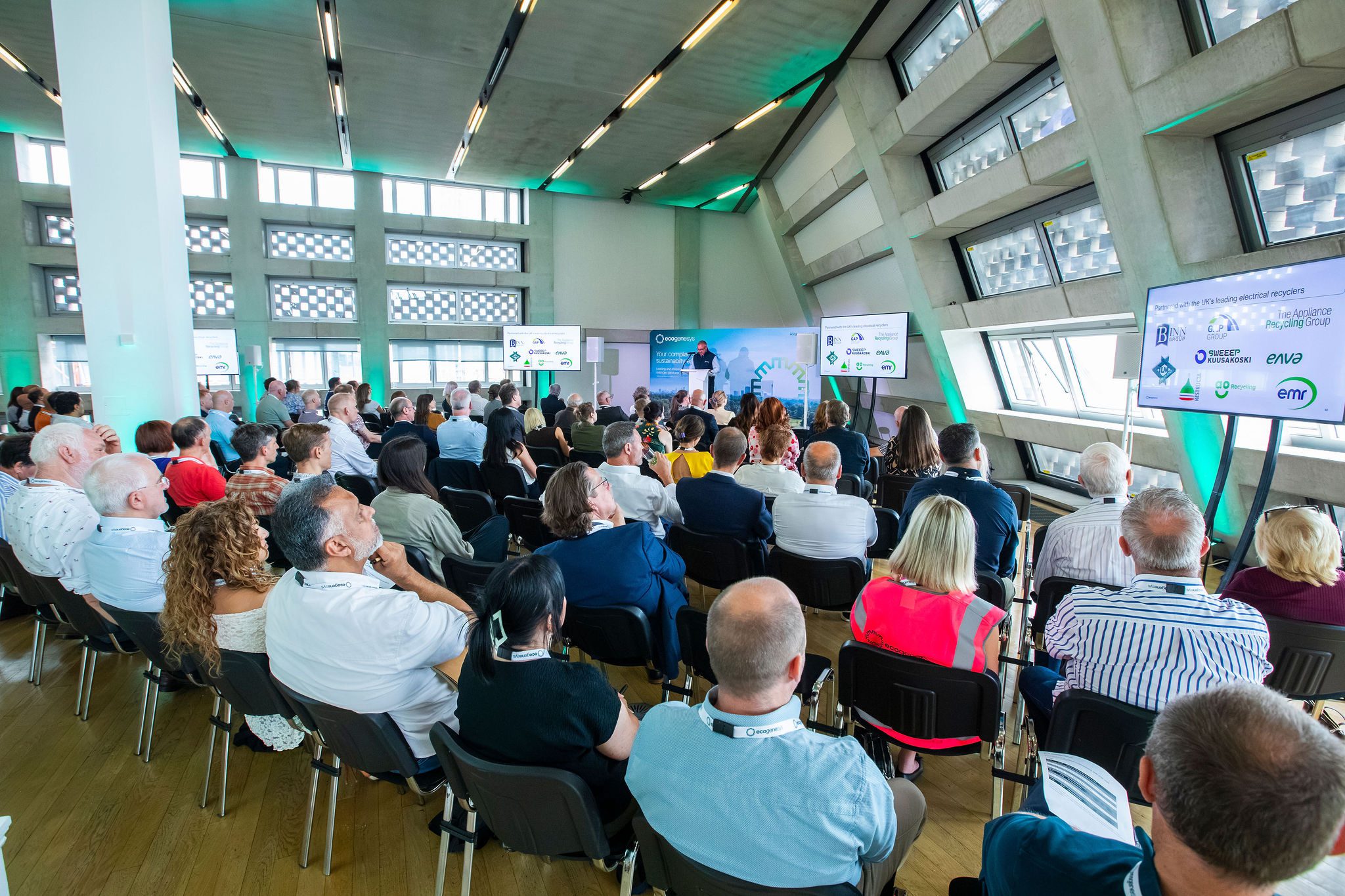
Ecogenesys welcomed more than 100 members, partners and stakeholders to its Summer Conference and Annual General Meeting at the Tate Modern in London on Wednesday 1st July.
Bringing together influential speakers, policymakers and industry leaders from across the UK and Europe, the event reinforced Ecogenesys’ role as a trusted partner, helping members navigate an increasingly complex policy landscape while celebrating the environmental progress achieved through producer responsibility.
As the UK’s leading member-owned producer compliance scheme, Ecogenesys is uniquely placed to connect producers with policymakers, regulators, researchers and delivery partners, ensuring members remain informed, prepared and actively involved in shaping the future of the circular economy.
Helping members make sense of a changing world
Against a backdrop of rapidly evolving UK and European legislation, delegates heard from representatives at Defra, PackUK, Material Focus, UNITAR and the WEEE Forum, who shared insights into policy developments, circular economy ambitions and emerging opportunities across the producer responsibility landscape.
Alongside updates from the Ecogenesys leadership team on organisational performance and future priorities, the conference focused on helping members understand what lies ahead, the challenges facing the sector and the opportunities to influence future policy.

Abs Bokhari, Executive Chairman of Ecogenesys, said:
“Our Summer Conference is about much more than reflecting on the year that’s passed. We operate in a complicated world and increasingly our role is to help make sense of it.
We see ourselves as facilitators – connecting members with policymakers, industry experts and stakeholders, keeping them informed about what’s coming and helping them prepare for future challenges.
By working closely with government and our partners across the UK and Europe, we’re able to represent a practical, real-world perspective that reflects the experience of producers and the recycling sector.”

Recognising producers’ environmental contribution
The conference also recognised the significant contribution that electrical producers have made to improving the environmental performance of products and supporting the transition to a more circular economy.
While producers have long funded the UK’s collection, transport, treatment and recycling systems for waste electricals, batteries and packaging through producer responsibility, their contribution extends far beyond regulatory compliance. Continued investment in eco-design, energy labelling, product innovation and increased use of recycled materials has helped transform the environmental performance of household appliances, reducing energy consumption, improving resource efficiency and delivering tangible environmental benefits for consumers and society.
Industry data from APPLiA highlights the scale of this impact. The European home appliance sector contributes nearly €79.7 billion in value added to EU GDP, supports nearly one million jobs and since 2019, improvements in energy-efficient appliances have contributed to a reduction of around 12 million tonnes of oil equivalent (Mtoe) in energy consumption across Europe.

Celebrating members’ environmental impact
During the event, Ecogenesys also celebrated a significant milestone, revealing that its members’ recycling activities have prevented an estimated 4.6 million tonnes of CO₂e since the introduction of the UK’s Waste Electrical and Electronic Equipment (WEEE) Regulations.
The figure is calculated using the Ecogenesys Carbon Model, independently peer reviewed to ISO 14044 standard, which provides members with verified carbon impact reports demonstrating the environmental benefits delivered through responsible electrical recycling activities.
Carbon saving certificates were presented to members during the conference, recognising their individual contribution to reducing emissions and recovering valuable resources.

Looking ahead
The conference concluded with a strong message that delivering meaningful environmental progress requires collaboration, innovation and pragmatic policymaking.
Abs Bokhari, concluded: “The progress we’ve made has only been possible because producers have continued to innovate, invest and collaborate across the entire value chain.
“As we look to the future, it’s essential that environmental ambition is matched by commercial reality. Sustainable environmental solutions can only be built on sustainable commercial foundations.”
By bringing together producers, policymakers, researchers and industry experts, the Ecogenesys Summer Conference continues to provide an important forum for collaboration, helping shape practical solutions that support both environmental progress and sustainable growth.